






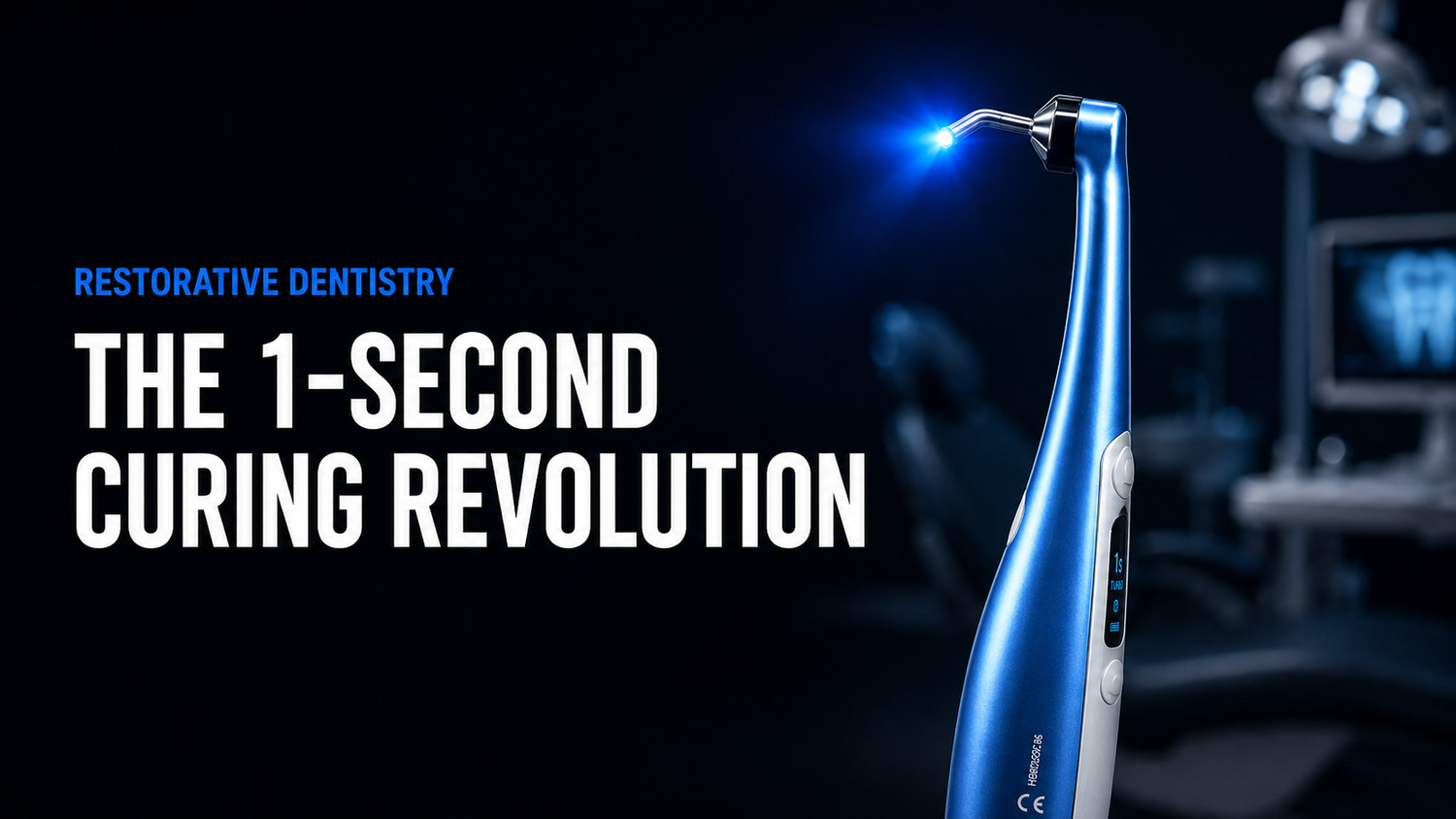
La lámpara de polimerización es la herramienta que utilizas con casi todos los pacientes, y los segundos que consume se acumulan silenciosamente hasta convertirse en horas. Estas son las cuentas que nadie hace y la forma en que una lámpara Turbo de alta intensidad te devuelve ese tiempo sin comprometer la polimerización.
La herramienta que utilizas con todos y cada uno de tus pacientes
Restauraciones de composite, selladores, adhesión, cementación, aditamentos de ortodoncia: la lámpara de polimerización aparece en casi todos los procedimientos. La mayoría de los profesionales se obsesionan con sus piezas de mano, sus lupas e incluso sus sillones. ¿La lámpara de polimerización? Simplemente permanece ahí hasta que la necesitas. Pero, como la utilizas tan a menudo, incluso unos segundos adicionales por polimerización se convierten en algo mucho mayor a lo largo de una semana, un mes o un año.
Las cuentas que nadie hace
Una lámpara de polimerización estándar suele requerir 10–20 segundos por incremento. Un solo composite posterior puede necesitar varias polimerizaciones: cada capa, además de una polimerización final de la superficie. Se acumula rápidamente:
- 3–4 ciclos de polimerización de 20 segundos cada uno ≈ 60–80 segundos de estar ahí de pie, con la lámpara en la mano, por restauración.
- 15 restauraciones al día ≈ 15–20 minutos de puro «sostener la lámpara».
- A lo largo de una semana laboral, eso supone alrededor de 90 minutos: durante un año, días de tiempo clínico empleados esperando a que termine la polimerización.
Estas cifras son ilustrativas y tu combinación de procedimientos será diferente. Pero la tendencia es innegable: una polimerización lenta es un pequeño impuesto que pagas con casi todos los pacientes, durante todo el día, todos los días. Reduce la polimerización de 20 segundos a 1 y recuperarás ese tiempo.
Lámpara de polimerización antigua frente a Turbo de alta intensidad: comparación lado a lado
| Lo que importa | Lámpara antigua / económica típica | LED Turbo de alta intensidad |
|---|---|---|
| Tiempo de polimerización | 10–20 s por incremento | Tan solo 1 s (materiales compatibles) |
| Intensidad de la luz | Más baja / disminuye con el tiempo | Alta intensidad de 1.000–2.500 mW/cm² |
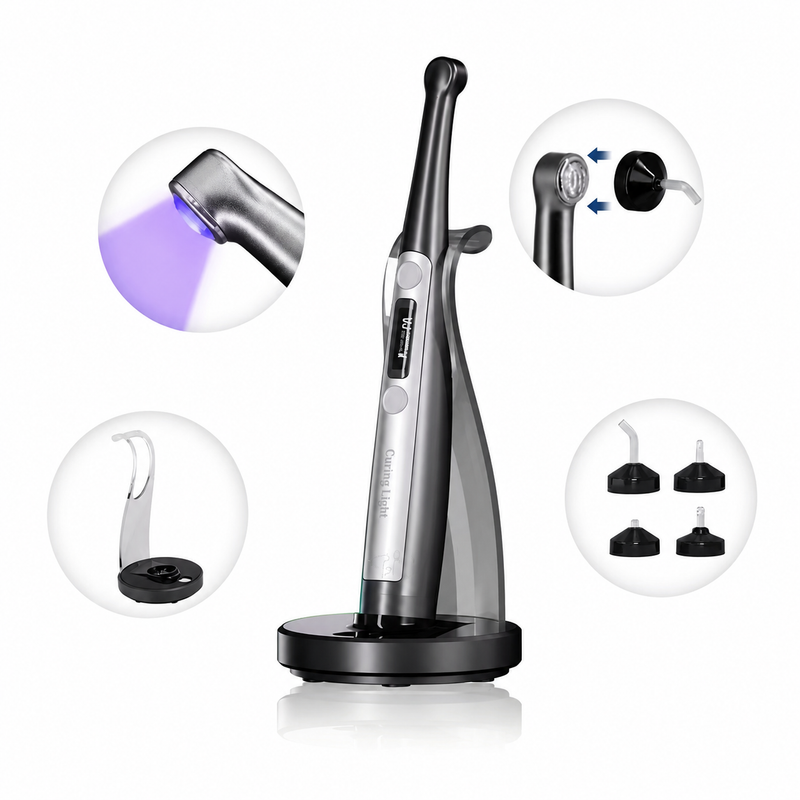
| Modos | 1–2 modos | 4 modos: Turbo · Normal · Ortodoncia · Comprobación |
| Diseño | Con cable, voluminosa | Inalámpara, ligera y ergonómica |
Los tiempos de polimerización más rápidos se aplican a materiales compatibles utilizados según el protocolo del fabricante; confirma siempre el tiempo de polimerización del composite específico que estás colocando.
Por qué esos segundos realmente importan
El tiempo en el sillón es tu recurso más limitado. El tiempo que pasas esperando a que termine la polimerización es tiempo que no dedicas a finalizar el caso, preparar de nuevo la sala o atender al siguiente paciente. Los procedimientos más cortos permiten una agenda más fluida y mayor capacidad, sin trabajar más horas.
La fatiga es real. Mantener la lámpara estable, una y otra vez, durante toda una jornada de restauraciones supone un desgaste silencioso para la mano, la muñeca y la concentración. Al llegar al último paciente, el cuerpo lo nota.
Los pacientes también lo notan. Pasar menos tiempo con la boca abierta y los instrumentos colocados resulta sencillamente más cómodo, y la comodidad impulsa las reseñas y las recomendaciones.
Qué hace realmente que una lámpara sea más rápida
Cuando evalúes una lámpara de polimerización por su velocidad, mira más allá del marketing y comprueba los aspectos fundamentales:
- Intensidad de la luz (mW/cm²). Una irradiancia mayor proporciona la energía necesaria en menos tiempo. Las potencias de entre 1.000 y 2.500 mW/cm² son las que permiten una polimerización realmente rápida.
- Un modo Turbo específico. Para composites compatibles, un ciclo corto de alta intensidad puede reducir drásticamente el tiempo de polimerización frente a los 20 segundos estándar.
- Varios modos. Turbo para mayor velocidad, además de modos estándar, de ortodoncia y de comprobación: una sola lámpara para cada situación clínica.
- Diseño inalámbrico y ergonómico. Una pieza de mano inalámbrica y ligera mejora el acceso y reduce la fatiga.
- Potencia constante y uniforme. Un haz estable garantiza una polimerización fiable en cada uso y menos repeticiones.
Una advertencia importante: nunca sacrifiques una polimerización adecuada por ganar velocidad
Más rápido solo es mejor si el material está completamente polimerizado. Una polimerización insuficiente aumenta el riesgo de restauraciones más débiles, deterioro marginal y problemas de biocompatibilidad. La forma correcta de ir más rápido:
- Sigue siempre el tiempo de polimerización recomendado por el fabricante del composite y el protocolo del fabricante de la lámpara. Los ciclos más cortos solo se aplican a materiales compatibles.
- Adapta la potencia de tu lámpara al tono, el grosor del incremento y el material.
- La velocidad debe provenir de una mayor intensidad que proporcione la misma energía más rápido, no de acortar el tiempo de polimerización.
Usada correctamente, una lámpara de alta intensidad logra una polimerización adecuada en menos tiempo. Esa es la verdadera ventaja: la misma calidad de polimerización, menos segundos.
Si una lámpara más rápida le ahorra incluso unos 90 minutos de tiempo clínico a la semana, se amortiza en cuestión de semanas y después sigue compensándole con cada paciente.
La conclusión rápida
Su lámpara de fotopolimerización entra en contacto con casi todos los pacientes, por lo que su velocidad es una de las mejoras con mayor impacto en el gabinete. Haga sus propios cálculos: multiplique el tiempo de fotopolimerización habitual por el número de fotopolimerizaciones diarias y, después, por los días del año. Si el total le sorprende, una lámpara inalámbrica de alta intensidad y varios modos —utilizada según el protocolo de fotopolimerización adecuado— es una de las formas más sencillas de recuperar tiempo clínico, reducir la fatiga y mantener cómodos a los pacientes.
Preguntas frecuentes
¿Se puede fotopolimerizar cualquier composite en 1 segundo?
No. Los ciclos más rápidos se aplican a materiales compatibles y de alta reactividad utilizados según el protocolo del fabricante. Confirme siempre el tiempo de fotopolimerización del composite específico y del incremento que está colocando.
¿Es segura una lámpara de alta intensidad?
Si se utiliza según las indicaciones —a la distancia, durante el tiempo y con la protección ocular adecuados—, sí. Siga las instrucciones de la lámpara y tenga en cuenta la exposición de los tejidos blandos y el calor con intensidades muy altas.
¿Una lámpara más rápida realmente cambiará mi día?
Para las clínicas de restauración y ortodoncia con un gran volumen de pacientes, ahorrar segundos en cada fotopolimerización se traduce en un tiempo clínico considerable a lo largo de semanas y meses.
Este artículo tiene fines educativos generales y no sustituye las instrucciones del fabricante ni su criterio clínico. Siga siempre los protocolos de fotopolimerización especificados por los fabricantes de sus materiales y dispositivos.