









Convertisseur de teinte VITA
Outil gratuit par Dentiphoto
Convertisseur de teintes VITA — Classical A1–D4 ↔ 3D-Master
Sélectionnez la teinte que vous avez déjà et obtenez la correspondance la plus proche dans l’autre système — avec un niveau de confiance honnête, car VITA n’a jamais publié de tableau de conversion universel.
Pour obtenir le résultat le plus cohérent, nous recommandons de confirmer la teinte avec le guide numérique des teintes Dentiphoto — il lit directement les deux systèmes sur la dent et indique l’écart réel de la correspondance.
Pourquoi les chiffres diffèrent
Les deux systèmes n’ont jamais été conçus pour correspondre parfaitement
Le VITA Classical A1–D4 (1956) a été organisé empiriquement, selon la fréquence d’apparition des teintes naturelles. Le VITA 3D-Master (1998) a été conçu pour couvrir l’espace colorimétrique à intervalles réguliers. VITA n’a jamais publié de tableau universel de correspondance entre les deux systèmes — seulement des approximations de la « correspondance la plus proche possible », liées à des moules de produits spécifiques. C’est pourquoi cet outil affiche un niveau de confiance au lieu de prétendre que chaque conversion est exacte.
Lire l’écran
Si vous utilisez un guide numérique des teintes Dentiphoto
L’appareil lit les deux systèmes à partir d’une seule mesure et colore le résultat selon la proximité réelle de la correspondance.
Correspondance nette. Utilisez la teinte telle quelle.
La dent se situe entre deux teintes. L’appareil affiche les deux — la valeur la plus élevée correspond à la teinte la plus proche. Avec 3D-Master, vous pouvez mélanger les deux matériaux à parts égales ou commander la teinte interpolée ; avec Classical, retenez la valeur la plus élevée, car les teintes Classical ne peuvent pas être mélangées.
Écart important. Ne l’envoyez pas au laboratoire. Recommencez la mesure, sinon la dent risque de se trouver complètement en dehors de la plage du teintier.
Le E220 affiche également une valeur ΔE — l’écart réel entre la dent et la teinte la plus proche. Vos onglets vous donnent un nom. Ils ne peuvent pas vous donner un chiffre.
Édition Dentiphoto · Précommande
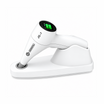
Guide numérique des teintes E220
VITA Classical et 3D-Master à partir d’une seule mesure, en environ une seconde, sous son propre éclairage calibré. La teinte la plus proche, la deuxième meilleure correspondance et une valeur ΔE.
Certifié CE · Garantie Dentiphoto de 1 an · Remboursement sous 30 jours · Livraison suivie gratuite
Avant toute conversion
Bien déterminer la teinte
Sept éléments qui déterminent si le numéro de départ méritait d’être converti.
-
01
Prenez la teinte dans les 5 à 10 premières minutes, avant que la dent ne se déshydrate et ne s’éclaircisse.
-
02
Tiers central de la surface vestibulaire, perpendiculaire à l’émail, à distance de la marge gingivale.
-
03
Évitez les fissures, les taches blanches, la fluorose, les anciennes obturations et les reflets spéculaires.
-
04
Dent non uniforme : évaluez séparément les tiers cervical, central et incisal, puis laissez le prothésiste stratifier en conséquence.
-
05
Utilisez une source lumineuse standardisée — et consignez les conditions d’éclairage avec le cas.
-
06
Remplacez vos plaquettes de teinte tous les deux ans. C’est la recommandation de VITA : la céramique se décolore.
-
07
Évaluez la dent, et non la plaquette considérée isolément.
Trois instruments, une seule décision
Trois façons de déterminer une teinte
| Plaquettes de teinte, à l’œil | Photo à polarisation croisée | Guide de teintes numérique | |
|---|---|---|---|
| Ce que vous obtenez | Un nom de teinte | Une image pour le prothésiste | Les deux systèmes, plus une valeur ΔE |
| Dépend de l’éclairage de la pièce | Oui — fenêtre, lampe, heure de la journée | Partiellement | Non — sa propre source lumineuse |
| Répétabilité | Varie selon les praticiens et les heures | Modérée | Cohérent lorsque l’embout est correctement positionné |
| Idéal pour | Cas simples, bonne lumière, temps disponible | Stratification complexe, travail avec un prothésiste | Confirmation avant l’envoi du cas au laboratoire |
Ce ne sont pas des alternatives : la plupart des dentistes utilisent les trois. Les onglets restent dans votre main ; c’est l’appareil qui vous indique l’écart avant que le cas ne parte au laboratoire.
Questions
Pourquoi l’outil indique-t-il une confiance « moyenne » ou « faible » ?
Parce que la correspondance sous-jacente est réellement incertaine pour ces teintes. VITA publie des approximations liées à des moules de produits spécifiques, et non une formule d’espace colorimétrique ; dans plusieurs cas, deux teintes classiques partagent une même valeur 3D-Master. Dix des seize teintes classiques se convertissent clairement ; six ne le font pas, et nous le précisons plutôt que de le dissimuler.
S’agit-il d’une conversion officielle de VITA ?
Non. VITA n’a jamais publié de tableau de conversion universel entre les deux systèmes. Cet outil est basé sur les approximations publiées par VITA, recoupées avec deux sources indépendantes, et vous indique le niveau de fiabilité de chaque entrée.
Pourquoi certaines teintes 3D-Master n’ont-elles aucun équivalent classique ?
Seize des vingt-neuf teintes 3D-Master n’ont aucun équivalent dans le système A1–D4. L’espace 3D-Master est tout simplement plus vaste et couvre des teintes que le guide classique ne peut pas exprimer. Si votre laboratoire travaille en classique, envoyez également la valeur 3D-Master.
Mon appareil affiche deux teintes qui ne correspondent pas à ce tableau. Est-il défectueux ?
Non. L’appareil trouve indépendamment la correspondance la plus proche dans chaque système à partir de la même mesure ; les deux champs peuvent donc être séparés d’un ou deux niveaux sur l’échelle de valeur VITA. Cet écart est une information : plus il est important, moins la dent s’intègre nettement dans l’un ou l’autre système. Utilisez l’onglet Guide de teintes numérique ci-dessus pour le consulter.
Puis-je envoyer directement la teinte convertie au laboratoire ?
Pour une conversion à forte confiance, oui. Pour une confiance moyenne ou faible, confirmez visuellement ou mesurez d’abord directement la dent : c’est précisément de là que viennent les reprises.
Mon guide de teintes a quelques années. Est-ce important ?
Oui. VITA recommande de remplacer les plaquettes de teinte tous les deux ans : la céramique se décolore, et une plaquette décolorée fausse chaque correspondance que vous établissez avec elle.
VITA classical A1–D4 et VITA SYSTEM 3D-MASTER sont des marques commerciales de VITA Zahnfabrik. Cet outil est une référence indépendante publiée par Dentiphoto et n’est ni approuvé ni affilié à VITA Zahnfabrik. Il aide à la prise de décision clinique, mais ne la remplace pas.