






Digital Dental Shade Guide · VITA Classical & 3D-Master
Same tooth. Three dentists. Three different shades.
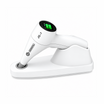
The Dentiphoto E220 reads VITA Classical and 3D-Master shades in 1 second — under its own light source. Operatory lighting, eye fatigue, and every doctor's “personal A2” no longer dictate which shade goes to the lab.
- VITA Classical A1–D4 and 3D-Master — both results on one screen
- Result in 1 second with a deviation indicator
- CE certified · 1-year warranty · 30-day money-back guarantee

The familiar story
The crown fit perfectly. The shade didn't.
The marginal fit is flawless. The contacts are spot on. Occlusion is fine. You are happy with the work — but the patient looks in the mirror and stays silent. Because the crown is half a shade darker than the adjacent tooth.
Then comes the familiar routine: a call to the lab, a remake, a return visit, a second seating. And a conversation with a person who has already paid $1,000+ and waited for two weeks.
The frustrating part is that it is not a manual error. You control the fit. You do not control the color. Shade matching by eye depends on variables you cannot control: the overhead lamp, the window, the time of day, and how many patients you have already seen.

Why visual shade matching drifts
Three things that change the shade — and you control none of them.
Lighting
The exact same tooth under the operatory lamp, near the window, and under ceiling lights can look different. Color is reflected light; change the source and you change what the eye sees.
Eyes
The human eye adapts. After repeated comparisons, shades start to blend. By the end of the day, the same tooth can look different than it did in the morning.
Lab transmission
A smartphone photo adds white balance, flash, and screen interpretation. “A2” on the prescription can become something between A2 and A3 by the time it reaches the technician.
It is not a skill problem. It is a lighting-and-eyes problem.
The cost of one error
One remake costs more than this device.
The lab bill for a remake is $150–400. Add a 30–60 minute return visit, removal, re-seating, materials, and the one cost that does not fit neatly on an invoice: the patient's trust.
The device costs $399.
One prevented remake, and it can pay for itself. A second one, and the economics are already working in your favor.
What the Dentiphoto E220 does
Spectrophotometer accuracy — $399, not $3,000.
The E220 does not just “look” at the tooth — it measures it. A built-in light source and sensor read the reflected spectrum, so the measurement does not depend on your operatory lighting.
In one second, the screen displays the closest VITA 3D-Master shade and VITA Classical shade. A green indicator means a clean match. An orange indicator shows a deviation and the second closest shade, giving the lab clearer direction than “roughly A2.”
No app, Bluetooth, or phone is required. The result is right on the screen in your hand.
Deviation indicator
Nearest shade plus direction when the tooth sits between tabs.
Two VITA systems
Classical and 3D-Master displayed from the same measurement.
Built-in light source
Measurement is independent of room and operatory light.
Professional support
CE certified · 1-year Dentiphoto warranty.


A second opinion for your eyes
It is not a replacement for your eyes. It is a second opinion for them.
You have been matching shades by eye for years — and most of the time, you get it right. The device is not meant to replace that skill, but to confirm your choice before the crown goes to the lab, not after it comes back wrong.
You look, the device measures. If they match, you send the case with confidence. If they differ, you have a reason to take another look and the lab gets a definitive number instead of a guess.
Repeatability
Five measurements. One result.
The practical test for any digital device is repeatability. Apply the E220 to the same tooth five times in a row and the point is simple: the reading should not drift with fatigue, room light, or who is holding the device.
The price comparison
Same task. Same VITA. Different price tag.
| Feature | Visual matching with a guide | Premium digital devices | Dentiphoto E220 |
|---|---|---|---|
| Price | $59–89 per guide | From $3,000 | $399 |
| Time to match shade | Several minutes of comparing under different lights | ~1 second | ~1 second |
| Dependence on operatory light | Complete | None — own light source | None — own light source |
| Repeatability | Depends on doctor, light, and time of day | High | High — repeat readings without visual fatigue |
| VITA Classical + 3D-Master | Two separate guides | Yes | Yes, on one screen |
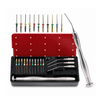
| What is needed to work | Daylight and a trained eye | Device, often software/app | Just the device. No app needed. |
| What you send to the lab | “Roughly A2” | A precise number | A precise number + deviation |
| Risk-free trial | — | Usually no | 30 days, money-back guarantee |
Who it is for
Who saves the most with the E220.
General Dentist & Prosthodontist
Every crown, veneer, or inlay means sending a shade to the lab. A hard number on the prescription replaces “roughly A2” with something the technician can actually use.
Aesthetic Dentist
The anterior zone is the least forgiving. The deviation indicator helps you and the technician discuss direction instead of guessing together.
Multi-Doctor Clinic
The assistant, junior doctor, and senior doctor can work from the same objective reading. For 2+ devices, contact Dentiphoto for a custom offer.
Why dentists choose the E220
Built around the things that matter in a real clinic.
30-day test drive
You are not buying it blind. You are trialing it for 30 days.
Put the E220 next to your chair and use it on restorative cases for a month. If it does not fit your workflow, send it back within the return period for a refund.
Your downside is limited. On the other side of the scale is the cost of the next shade-related remake.
Ships from warehouses in the US, Europe, and Australia · 7–14 business days · support responds within 24 hours
See the device — $399FAQ
Questions dentists ask before ordering.
How does the E220 differ from $3,000 digital devices?
What shade guides does it work with?
How accurate is it?
Does it require calibration or an app?
Can I test the device on VITA shade tabs?
How do I clean it between patients?
What is the battery life and format?
Where do you ship from and how long does it take?
What if it does not work for me?
Is there a warranty?
Dentiphoto E220 · Digital Dental Shade Guide