









Introducción
Elegir la guía de colores dentales adecuada es un paso esencial para lograr restauraciones de aspecto natural. Entre los sistemas más utilizados en todo el mundo, VITA Classical y VITA 3D-MASTER se han convertido en estándares del sector para comunicar el color de los dientes entre dentistas y laboratorios dentales. Aunque ambos están diseñados para mejorar la selección del color, siguen principios diferentes y ofrecen ventajas específicas según la situación clínica.
Muchos profesionales siguen confiando en la conocida guía VITA Classical por su sencillez y amplia adopción. Otros prefieren el sistema VITA 3D-MASTER, que organiza los colores según el valor, el croma y el tono para ofrecer un enfoque más sistemático de selección del color. Comprender las fortalezas y limitaciones de cada sistema puede ayudar a mejorar la comunicación, reducir la necesidad de rehacer trabajos y lograr resultados estéticos más predecibles.
En esta guía, compararemos ambas guías de colores en detalle, analizaremos sus aplicaciones clínicas y explicaremos cuál de los dos sistemas puede ser la mejor opción para su flujo de trabajo. Si es nuevo en la selección del color dental, le recomendamos leer nuestra guía completa sobre Selección del color dental: métodos, herramientas y mejores prácticas antes de explorar las diferencias entre estos dos sistemas de color.
Recomendación rápida
| Si usted es... | Elija |
|---|---|
| Estudiante de odontología | VITA Classical |
| Odontólogo general | VITA Classical |
| Odontólogo estético | VITA 3D-MASTER |
| Prostodoncista | VITA 3D-MASTER |
| Principalmente restauraciones posteriores | VITA Classical |
| Principalmente carillas | VITA 3D-MASTER |
| Primera guía de colores | VITA Classical |
| Ya utiliza dispositivos digitales para seleccionar el color | VITA 3D-MASTER |
Conclusiones clave
- VITA Classical es la guía de colores dentales más utilizada y es ideal para procedimientos restauradores rutinarios.
- VITA 3D-MASTER ofrece un enfoque más sistemático basado en el valor, el croma y el tono, por lo que resulta muy adecuada para casos altamente estéticos.
- Ambas guías de colores pueden producir excelentes resultados clínicos cuando se utilizan correctamente.
- VITA Classical es más fácil de aprender, mientras que VITA 3D-MASTER ofrece una mayor precisión en la selección del color.
- La mejor elección depende de su flujo de trabajo clínico, la comunicación con el laboratorio y los requisitos estéticos, no de que un sistema sea universalmente mejor.
Índice
- ¿Por qué existen dos guías de colores VITA diferentes?
- Descripción general de VITA Classical
- Descripción general de VITA 3D-MASTER
- VITA Classical frente a VITA 3D-MASTER: comparación lado a lado
- Aplicaciones clínicas: ¿qué guía de colores ofrece un mejor rendimiento?
- Odontología digital y selección del color
- ¿Qué guía de colores debería elegir?
- Preguntas frecuentes
- Conclusión
¿Por qué existen dos guías de colores VITA diferentes?
A primera vista, puede parecer innecesario contar con dos sistemas de guías de colores desarrollados por el mismo fabricante. Sin embargo, cada uno se creó para resolver distintos desafíos clínicos y refleja la evolución de la odontología estética a lo largo del tiempo.
VITA Classical y VITA 3D-MASTER fueron diseñados para distintas prioridades clínicas. VITA Classical hace hincapié en la sencillez, la rapidez y la amplia compatibilidad con materiales restauradores, mientras que VITA 3D-MASTER ofrece un enfoque más sistemático y detallado para casos estéticos exigentes. La elección adecuada depende del tipo de odontología que se practique, del sistema utilizado por el laboratorio y del nivel de precisión del tono que requieran los casos.
En lugar de sustituir a VITA Classical, el sistema 3D-MASTER amplió las posibilidades de comunicación del color. Actualmente, ambos sistemas siguen utilizándose ampliamente, y muchas consultas dentales disponen de ambas guías de tonos. La mejor opción suele depender de la experiencia del profesional, las preferencias del laboratorio, los materiales restauradores y la complejidad de cada caso.
Descripción general de VITA Classical
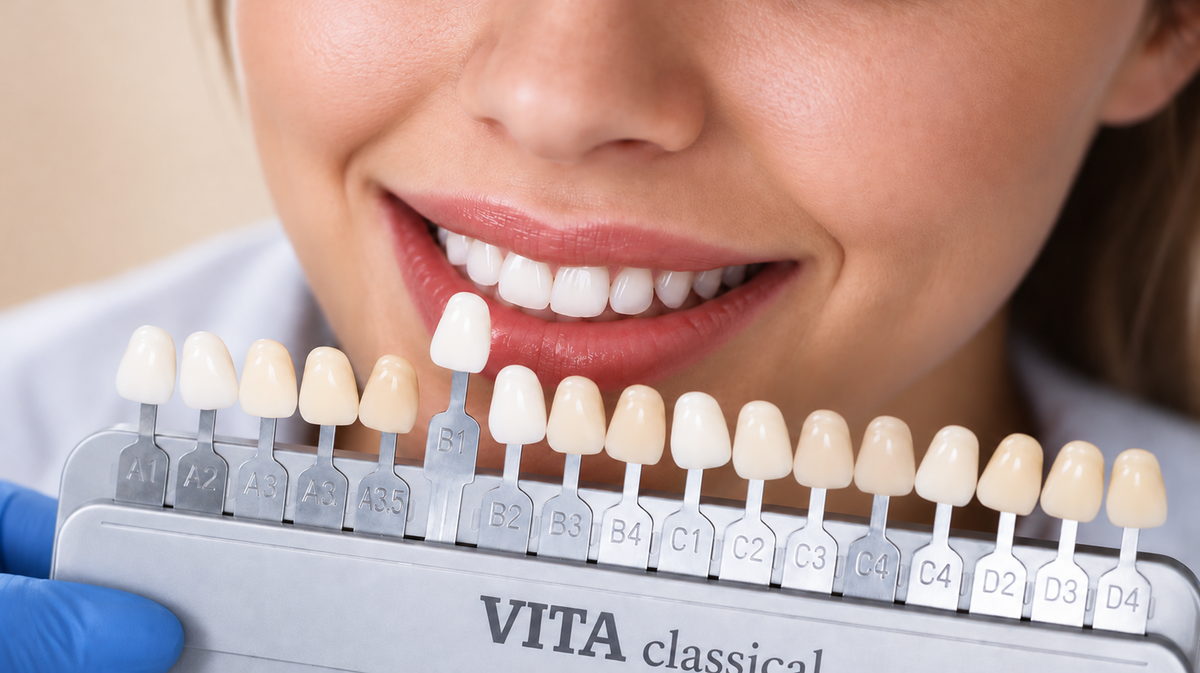
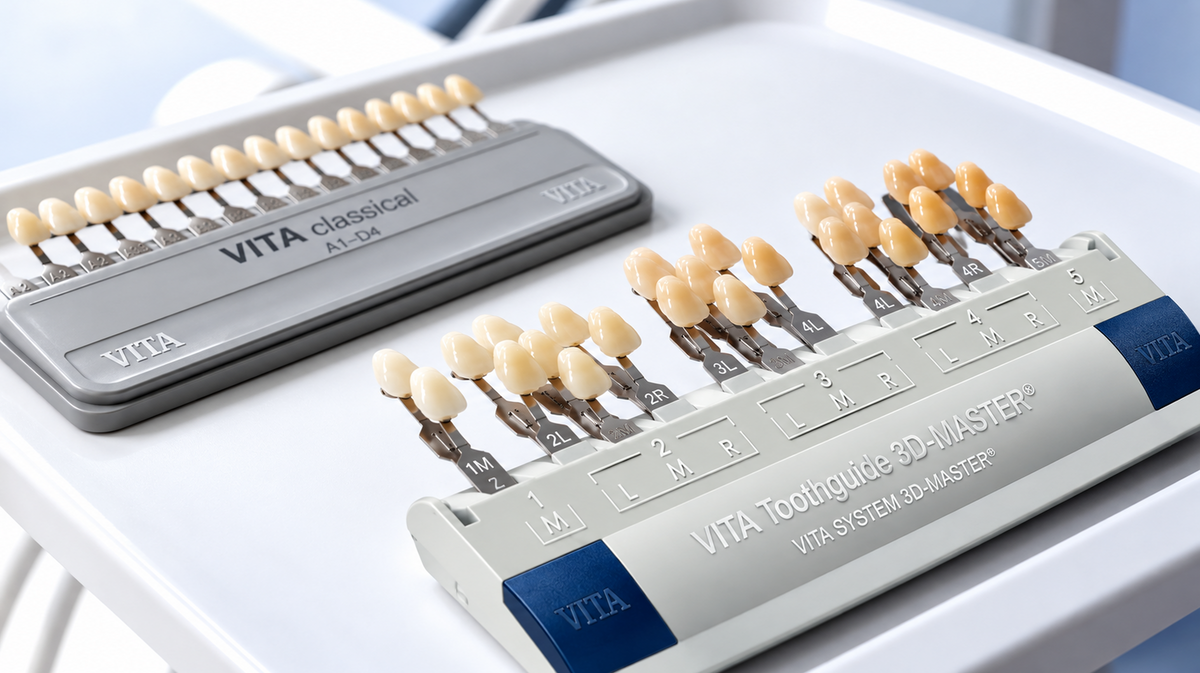
La guía de tonos VITA Classical A1–D4 ha sido un estándar de confianza en la odontología restauradora durante décadas. Su amplia adopción la ha convertido en uno de los sistemas de tonos más reconocidos del mundo, y muchos profesionales siguen utilizándola como herramienta principal para seleccionar el tono dental.
A diferencia de los sistemas más recientes, VITA Classical agrupa los tonos principalmente por el matiz (la familia básica de colores), seguido de las diferencias de croma (saturación del color). La guía consta de 16 pestañas divididas en cuatro categorías:
- A – tonos marrón rojizo
- B – tonos amarillo rojizo
- C – tonos grises
- D – tonos gris rojizo
Dentro de cada grupo, los números generalmente representan un croma creciente: los números más bajos indican tonos más claros y menos saturados, mientras que los números más altos representan colores más oscuros y saturados.
Una de las mayores ventajas del sistema VITA Classical es que resulta familiar. La mayoría de los dentistas, técnicos dentales, higienistas y fabricantes han trabajado con él durante años, lo que facilita la comunicación entre distintas consultas y laboratorios. Como muchos materiales restauradores, incluidos composites, cerámicas y dientes para prótesis, están etiquetados según los tonos VITA Classical, a menudo es sencillo y eficaz hacer coincidir los materiales con el tono seleccionado.
El sistema también es fácil de aprender. Los estudiantes de odontología y los profesionales recién titulados normalmente pueden familiarizarse con la guía tras un breve periodo de práctica. Esta accesibilidad ha ayudado a que VITA Classical siga siendo la opción preferida en muchas consultas dentales generales.
Ventajas de VITA Classical
- Fácil de aprender y utilizar.
- Ampliamente reconocida por dentistas y laboratorios dentales de todo el mundo.
- Compatible con la mayoría de los materiales restauradores.
- Excelente para procedimientos restauradores habituales.
- Rápida y eficiente para los flujos de trabajo clínicos cotidianos.
Limitaciones de VITA Classical
- Número limitado de muestras de color en comparación con los sistemas más recientes.
- Algunos tonos de dientes naturales quedan entre las referencias existentes.
- Organización menos sistemática para casos altamente estéticos.
- Puede ser más subjetiva al distinguir tonos similares.
Aunque las guías de colores más recientes ofrecen mayor precisión, VITA Classical sigue siendo uno de los sistemas más prácticos y universalmente aceptados en la odontología moderna. Su fiabilidad, sencillez y adopción mundial explican por qué continúa siendo la primera opción para muchos profesionales, a pesar de la disponibilidad de alternativas más avanzadas.
¿Quién debería comprar VITA Classical?
VITA Classical es la mejor opción para consultas dentales generales, estudiantes de odontología y profesionales que realizan principalmente procedimientos restauradores habituales. También es la opción más segura cuando la mayoría de los materiales restauradores y las prescripciones de laboratorio utilizan referencias de color A1–D4.

Descripción general de VITA 3D-MASTER
Presentada como un sistema de tonos de nueva generación, VITA 3D-MASTER se desarrolló para ofrecer un enfoque más sistemático y científicamente estructurado para la selección del color dental.
Esta organización permite a los profesionales evaluar el color dental paso a paso, en lugar de identificar simultáneamente todas sus características cromáticas. Al reducir la interpretación subjetiva, el sistema ayuda a mejorar la uniformidad y la comunicación con los laboratorios dentales.
A diferencia de la guía VITA Classical de 16 tonos, el sistema VITA 3D-MASTER ofrece una gama más amplia de muestras de color, lo que permite a los profesionales igualar las variaciones sutiles presentes en los dientes naturales. Esta selección ampliada de tonos es especialmente valiosa en odontología estética, donde incluso pequeñas diferencias de luminosidad o saturación pueden afectar significativamente al aspecto final de una restauración.
Sin embargo, la mayor precisión conlleva una curva de aprendizaje más pronunciada. Los profesionales acostumbrados al conocido sistema A1–D4 suelen necesitar capacitación adicional antes de sentirse cómodos utilizando la guía 3D-MASTER. El mayor número de muestras de color también puede hacer que el proceso de selección sea ligeramente más largo, especialmente durante las primeras etapas de adopción.
VITA 3D-MASTER ofrece el máximo valor en casos restauradores altamente estéticos, mientras que muchas consultas generales pueden considerar suficiente VITA Classical para los procedimientos habituales.
Ventajas de VITA 3D-MASTER
- Organizada científicamente según el valor, el croma y el matiz.
- Gama de colores más amplia para una mayor precisión cromática.
- Representa mejor las variaciones naturales del color dental.
- Adecuada para casos cosméticos y restauradores complejos.
- Se integra eficazmente con las tecnologías digitales de selección del color.
Limitaciones de VITA 3D-MASTER
- Requiere más formación que VITA Classical.
- Una selección más amplia de colores puede aumentar el tiempo de decisión junto al sillón dental.
- No todos los materiales restauradores están disponibles en todos los colores 3D-MASTER.
- Algunos laboratorios todavía se comunican principalmente mediante el sistema VITA Classical.
Aunque VITA 3D-MASTER suele considerarse el sistema más avanzado, no necesariamente es la mejor opción para todos los profesionales ni para todos los procedimientos. Su mayor fortaleza se encuentra en situaciones en las que la reproducción precisa del color es fundamental y las tecnologías digitales ya forman parte del flujo de trabajo restaurador.
¿Quién debería comprar VITA 3D-MASTER?
Vale la pena considerar VITA 3D-MASTER para dentistas cosméticos, prostodoncistas y consultorios que realizan con frecuencia carillas, restauraciones cerámicas anteriores, coronas sobre implantes o rehabilitaciones completas de la sonrisa. Es especialmente útil cuando el laboratorio ya trabaja con el sistema 3D-MASTER.

VITA Classical frente a VITA 3D-MASTER: comparación lado a lado
Elegir entre estas dos guías de colores no consiste tanto en determinar cuál es «mejor», sino en seleccionar el sistema que mejor se adapte a tu flujo de trabajo clínico, tus objetivos restauradores y tu comunicación con el laboratorio dental. Aunque ambos sistemas pueden producir excelentes resultados estéticos, difieren en varios aspectos importantes.
| Característica | VITA Classical | VITA 3D-MASTER |
|---|---|---|
| Introducción | Guía de colores tradicional utilizada durante décadas | Guía de colores moderna basada en la ciencia del color |
| Número de colores | 16 colores estándar | Gama de colores ampliada con más opciones intermedias |
| Organización de los colores | Agrupada por matiz (A–D) | Organizada por valor, croma y matiz |
| Facilidad de aprendizaje | Muy fácil | Curva de aprendizaje moderada |
| Flujo de trabajo clínico | Rápida y familiar | Más sistemática, pero inicialmente un poco más lenta |
| Precisión del color | Excelente para casos rutinarios | Mayor precisión para casos estéticos complejos |
| Representación del diente natural | Buena | Excelente |
| Comunicación con los laboratorios | Estándar universal | Cada vez más común en laboratorios avanzados |
| Integración con flujos de trabajo digitales para la selección del color | Ampliamente compatible | Particularmente adecuada |
| Más adecuada para | Odontología restauradora cotidiana | Odontología cosmética y de alta estética |
| La mejor opción para compradores primerizos | Sí | Más adecuada para usuarios experimentados |
| Formación necesaria | Mínima | Moderada |
| Disponibilidad de materiales | Muy amplia | Puede variar según el fabricante |
| Compatibilidad con laboratorios | Casi universal | Confirma antes de comprar |
| La mejor relación calidad-precio para | Odontología rutinaria | Odontología de alta estética |
| ¿Debería ser tu única guía? | Sí, para muchas prácticas generales | Sí, si tu flujo de trabajo lo admite |
Aunque esta comparación destaca las diferencias técnicas, el impacto práctico depende en gran medida del tipo de restauraciones que se realicen. Un profesional que coloca restauraciones posteriores con composite todos los días puede obtener pocos beneficios al cambiar a un sistema más complejo. En cambio, un prostodoncista que restaura dientes anteriores muy visibles puede valorar la mayor precisión que ofrece VITA 3D-MASTER.
En muchas consultas, los dos sistemas no compiten, sino que son herramientas complementarias. Los odontólogos pueden utilizar VITA Classical para procedimientos habituales y recurrir a VITA 3D-MASTER —o al análisis digital del color— en casos en los que la estética exige un mayor nivel de precisión. Este enfoque flexible permite equilibrar eficiencia y precisión, manteniendo una comunicación clara con el laboratorio dental.
Aplicaciones clínicas: ¿qué guía de colores ofrece un mejor rendimiento?
Tanto VITA Classical como VITA 3D-MASTER son capaces de producir excelentes resultados restauradores cuando se utilizan correctamente. Sin embargo, sus puntos fuertes se hacen más evidentes en distintas situaciones clínicas. La elección suele depender de la complejidad del caso, las expectativas estéticas del paciente y el flujo de comunicación entre el odontólogo y el laboratorio dental.
Odontología restauradora habitual
Para procedimientos cotidianos como restauraciones posteriores con composite, coronas individuales en zonas menos visibles y trabajos protésicos habituales, VITA Classical sigue siendo una excelente opción.
Su organización sencilla permite a los profesionales determinar el tono rápidamente, reduciendo el tiempo en el sillón mientras mantiene resultados fiables. Dado que la mayoría de los materiales restauradores están etiquetados según el sistema VITA Classical, seleccionar el tono adecuado de composite o cerámica es sencillo.
Para las consultas centradas principalmente en la odontología general, VITA Classical suele ofrecer el equilibrio ideal entre eficiencia y precisión.
Mejor opción: VITA Classical
Coronas y carillas anteriores
Las restauraciones anteriores presentan un mayor desafío estético porque incluso las discrepancias menores de color se vuelven inmediatamente perceptibles.
Los dientes naturales presentan variaciones sutiles en luminosidad, translucidez y saturación que son difíciles de describir utilizando únicamente 16 tonos estándar. En estas situaciones, VITA 3D-MASTER ofrece una ventaja significativa al proporcionar una gama más amplia de tonos intermedios y un enfoque más estructurado para la selección del color.
Para carillas de porcelana, restauraciones de disilicato de litio y coronas cerámicas altamente estéticas, la precisión adicional puede mejorar la comunicación con el laboratorio y reducir la probabilidad de tener que ajustar el color después de la colocación.
Mejor opción: VITA 3D-MASTER
Restauraciones soportadas por implantes
La selección del color alrededor de los implantes puede ser especialmente difícil porque las restauraciones sobre implantes suelen carecer de las propiedades ópticas naturales de los dientes vitales. Las características de los tejidos blandos, los materiales restauradores y las condiciones de iluminación influyen en el aspecto final.
El uso de un sistema de colores más detallado ayuda a los técnicos a reproducir estas diferencias sutiles con mayor precisión, especialmente cuando se combina con fotografías clínicas de alta calidad y análisis digital del color.
Mejor opción: VITA 3D-MASTER, especialmente para implantes unitarios anteriores.
Rehabilitación completa de la sonrisa
Para rehabilitaciones completas de la sonrisa, VITA 3D-MASTER generalmente ofrece una mejor relación calidad-precio porque su organización sistemática, basada primero en el valor, ayuda a mantener la uniformidad entre múltiples restauraciones. Es especialmente beneficioso cuando el profesional tratante y el laboratorio utilizan el mismo flujo de trabajo para la selección del color.
Mejor opción: VITA 3D-MASTER
Restauraciones directas de composite
Las restauraciones de composite suelen completarse en una sola cita, por lo que la eficiencia es una consideración importante.
La mayoría de los fabricantes de composites siguen utilizando referencias de color VITA Classical, lo que permite a los profesionales seleccionar rápidamente los materiales restauradores sin tener que convertir entre distintos sistemas.
Para restauraciones rutinarias de clase III, IV y V, VITA Classical sigue siendo la opción más práctica. Sin embargo, en técnicas de estratificación de composite anterior altamente estéticas, algunos profesionales complementan la guía Classical con fotografía digital o análisis avanzado del color para lograr una mayor precisión.
Mejor opción: VITA Classical
Trabajo con el laboratorio dental
El éxito de la selección del color depende no solo de elegir el color correcto, sino también de comunicarlo eficazmente.
Si su laboratorio utiliza principalmente VITA Classical, adoptar VITA 3D-MASTER puede no mejorar los resultados de inmediato, a menos que ambas partes sigan el mismo flujo de trabajo. Por el contrario, los laboratorios especializados en odontología estética utilizan cada vez más VITA 3D-MASTER porque su organización estructurada permite comunicar el color con mayor detalle.
Antes de cambiar de sistema de colores, conviene analizar el flujo de trabajo preferido de su laboratorio y asegurarse de que todas las personas involucradas en el proceso restaurador utilicen el mismo sistema de referencia.
Recomendaciones clínicas de un vistazo
| Situación clínica | Guía de colores recomendada |
|---|---|
| Odontología restauradora rutinaria | VITA Classical |
| Coronas posteriores | VITA Classical |
| Restauraciones directas de composite | VITA Classical |
| Carillas de porcelana | VITA 3D-MASTER |
| Coronas cerámicas anteriores | VITA 3D-MASTER |
| Restauraciones sobre implantes | VITA 3D-MASTER |
| Rehabilitación completa de la sonrisa | VITA 3D-MASTER |
| Práctica odontológica general | VITA Classical |
| Práctica odontológica estética y prostodóntica | VITA 3D-MASTER |
Compatibilidad con flujos de trabajo digitales para la selección del color
Ambas guías de colores pueden utilizarse en flujos de trabajo digitales para la selección del color, pero VITA 3D-MASTER suele adaptarse mejor a las consultas que dependen en gran medida de espectrofotómetros y sistemas avanzados de medición del color. Su organización por valor, croma y matiz permite una comunicación más detallada del color en casos restauradores complejos.
Sin embargo, la compatibilidad digital por sí sola no debería determinar tu compra. Antes de elegir una guía, confirma qué sistema de colores es compatible con tu dispositivo preferido, tus materiales restauradores y tu laboratorio dental. Una guía técnicamente avanzada ofrece un valor limitado si el resto de tu flujo de trabajo sigue dependiendo principalmente de las referencias de VITA Classical.

Qué debes considerar antes de comprar una guía de colores VITA
Antes de comprar una guía de colores, considera cómo se integrará en tu flujo de trabajo clínico y de laboratorio diario. Un sistema más avanzado no es automáticamente una mejor inversión si rara vez necesitas su precisión adicional en tus casos.
\Tipo de odontología: Las consultas generales que realizan composites rutinarios, coronas posteriores y trabajos protésicos habituales normalmente obtendrán la mejor relación calidad-precio con VITA Classical. Las consultas de odontología estética y prostodoncia pueden beneficiarse más de VITA 3D-MASTER.
\Compatibilidad con el laboratorio: Pregunta a tu laboratorio dental qué sistema utiliza con mayor frecuencia. La comunicación del color es más eficaz cuando la clínica y el laboratorio trabajan con las mismas referencias.
\Disponibilidad de materiales restauradores: Muchos composites, materiales cerámicos y dientes para prótesis están etiquetados según los colores de VITA Classical. Antes de seleccionar 3D-MASTER como guía principal, confirma que los materiales que utilizas estén disponibles en colores compatibles.
\Formación y facilidad de uso: Todo el equipo puede adoptar VITA Classical rápidamente. VITA 3D-MASTER requiere un proceso de selección más estructurado y puede implicar formación adicional.
\Presupuesto: Aunque VITA 3D-MASTER ofrece una mayor precisión en la selección del color, muchas consultas dentales generales logran excelentes resultados clínicos únicamente con VITA Classical. Considera si las capacidades adicionales justifican la inversión según los tipos de casos que tratas con mayor frecuencia.
\Volumen de casos: Si los casos anteriores altamente estéticos representan solo una pequeña parte de tu carga de trabajo, VITA Classical puede ser suficiente como guía principal. Si las carillas, las coronas anteriores y las restauraciones sobre implantes son fundamentales en tu consulta, la precisión adicional de VITA 3D-MASTER puede justificar la inversión.
¿Qué guía de colores debería elegir?
La guía de colores adecuada depende del tipo de odontología que realiza y del nivel de precisión estética que requieren sus casos.
Elija VITA Classical si:
- Realiza principalmente procedimientos restauradores rutinarios.
- Prefiere un flujo de trabajo sencillo y familiar.
- Trabaja con laboratorios que utilizan principalmente el sistema Classical.
- Desea una selección rápida del color en el sillón dental.
- Utiliza con frecuencia materiales restauradores etiquetados según los colores de VITA Classical.
Elija VITA 3D-MASTER si:
- Se centra en la odontología estética o la prostodoncia.
- Restaura dientes anteriores muy visibles.
- Realiza tratamientos con carillas y casos de diseño de sonrisa.
- Utiliza tecnologías digitales de igualación del color.
- Necesita una mayor precisión para restauraciones estéticas exigentes.
La mejor opción para la mayoría de las consultas dentales generales
Para la mayoría de las consultas dentales generales que compran una sola guía de colores, VITA Classical es la opción inicial más práctica. Es más fácil de utilizar, goza de amplio reconocimiento y es compatible con una gran variedad de materiales restauradores.
La mejor opción para consultas de estética y prostodoncia
En las consultas donde la estética anterior, las carillas, las coronas sobre implantes y las restauraciones cerámicas complejas representan una parte importante del trabajo, es probable que VITA 3D-MASTER ofrezca un mayor valor a largo plazo.
¿Debería comprar ambas?
Comprar ambos sistemas puede ser útil para las consultas que realizan una combinación de tratamientos dentales rutinarios y de alta exigencia estética. VITA Classical puede facilitar la selección rápida del color en el día a día, mientras que VITA 3D-MASTER puede reservarse para los casos que requieren un análisis cromático más detallado. Sin embargo, una consulta general pequeña quizá no necesite ambas guías de inmediato.
Preguntas frecuentes
¿Es VITA 3D-MASTER más preciso que VITA Classical?
VITA 3D-MASTER ofrece una gama más amplia de colores y una organización sistemática basada en el valor, el croma y el tono, lo que puede mejorar la selección del color en casos estéticos exigentes. Sin embargo, ambos sistemas son capaces de ofrecer excelentes resultados cuando se utilizan correctamente.
¿Por qué muchos dentistas siguen utilizando VITA Classical?
Su sencillez, amplia adopción y compatibilidad con los materiales restauradores hacen de VITA Classical la opción preferida en muchas consultas dentales generales.
¿Se pueden utilizar ambas guías de colores con dispositivos digitales de igualación del color?
Sí. Ambos sistemas pueden incorporarse a los flujos de trabajo digitales, aunque muchos dispositivos modernos de medición del color están diseñados para integrarse especialmente bien con el sistema VITA 3D-MASTER.
¿Debería sustituir mi guía VITA Classical por VITA 3D-MASTER?
No necesariamente. Si tu flujo de trabajo actual produce resultados satisfactorios de forma constante y coincide con el sistema de comunicación de tu laboratorio, puede haber pocos motivos para cambiar. Muchos profesionales optan por tener ambas guías disponibles y utilizarlas según la situación clínica.
¿Qué guía de colores es mejor para los estudiantes de odontología?
Por lo general, VITA Classical es más fácil de aprender gracias a su organización sencilla y a su uso universal. A medida que aumenta la experiencia clínica, aprender a utilizar el sistema VITA 3D-MASTER puede aportar mayor flexibilidad y mejorar la selección del color en casos restauradores más avanzados.
¿Qué guía de colores VITA debería comprar primero?
Para la mayoría de los estudiantes de odontología y odontólogos generales, VITA Classical es la primera compra más práctica porque es fácil de aprender y cuenta con un amplio respaldo de los materiales restauradores y los laboratorios.
¿Vale la pena tener las dos guías de colores VITA?
Puede ser una opción conveniente para las consultas que combinan la odontología restauradora habitual con un gran volumen de casos estéticos o prostodónticos. Las consultas generales con un volumen limitado de casos estéticos quizá no necesiten ambos sistemas de inmediato.
¿Vale la pena el costo adicional de VITA 3D-MASTER?
Puede valer la pena invertir en ella cuando se necesita regularmente una mayor precisión del color, especialmente para carillas, coronas cerámicas anteriores, restauraciones sobre implantes y rehabilitaciones completas de la sonrisa. Para los trabajos restauradores habituales, la complejidad adicional puede ofrecer un beneficio práctico limitado.
Conclusión
VITA Classical y VITA 3D-MASTER son sistemas de selección de color fiables, pero ofrecen ventajas diferentes según el entorno clínico.
Para la mayoría de las consultas dentales generales, estudiantes de odontología y profesionales que compran su primera guía de colores, VITA Classical sigue siendo la opción más práctica. Es fácil de usar, ampliamente reconocida por los laboratorios y compatible con una amplia variedad de materiales restauradores.
VITA 3D-MASTER es una inversión más conveniente para odontólogos especializados en estética, prostodoncistas y consultas que realizan con frecuencia restauraciones anteriores altamente estéticas. Su organización sistemática y su gama más amplia de colores pueden facilitar una comunicación más precisa en casos complejos, especialmente cuando el laboratorio utiliza el mismo sistema.
Antes de comprar, considera tus procedimientos más habituales, los materiales restauradores, el flujo de trabajo del laboratorio y la experiencia de tu equipo clínico. Para muchas consultas, una sola guía es suficiente. Si vas a comprar tu primera guía de colores, VITA Classical es la opción más segura para la mayoría de las consultas dentales generales. Si la odontología estética es un área importante de tu consulta, es probable que VITA 3D-MASTER ofrezca un mayor valor a largo plazo. Las consultas que realizan habitualmente ambos tipos de tratamientos pueden beneficiarse de tener los dos sistemas.